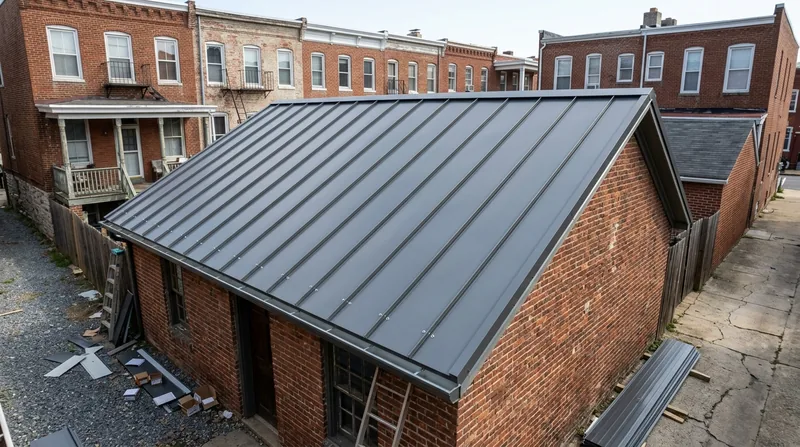




Corrugated & ribbed panel roofing in Washington is the exposed-fastener workhorse we install on alley garages, carriage houses, backyard studios, and sheds across the District. This city is not a suburb of wide lots and long driveways. It is block after block of 1870s-1920s brick rowhouses on Capitol Hill, Dupont Circle, Shaw, Columbia Heights, and Petworth, with narrow service alleys, tight side yards, and low-slope outbuildings tucked behind the main house. We set 5V crimp, corrugated, and R-panel profiles on those roofs with the right screw pattern, closures, and trim so they shed water instead of rusting through at the fastener. We have been on DC roofs since 2009, and we are a Metal Roofing Alliance Member. If you want the wider picture of what we do, start at our metal roof installation in Washington page.
Why Exposed-Fastener Panel Roofing Fits Washington's Alleys and Outbuildings
Most of the corrugated and ribbed work in the District is not on the main house. It is on the garage at the end of a Capitol Hill alley, the carriage house behind a Logan Circle rowhouse, the shed in a Brookland backyard, or the studio a homeowner built out back in Takoma. Those roofs are low-slope to shallow-pitch, small, and hard to reach with a truck, which is exactly where exposed-fastener panels make sense. They cost less than standing seam, go down fast, and handle DC's hot humid summers and violent thunderstorms without the oil-canning you get from wide flat panels.
The profile choice is not cosmetic. It decides how the roof handles water and how it ages:
- 5V crimp gives you the classic painted-tin look that matches the porch roofs and mansard details on Victorian rowhouses.
- Corrugated panels move water well on shallow pitches and stay affordable for sheds and garden structures.
- R-panel (ribbed) covers longer runs with fewer seams, which suits the long low roofs on carriage houses and 1940s-1950s brick colonials east of the Anacostia.
- Exposed fasteners mean every screw is a service point, so we set them on the rib, not in the pan, with the correct washer and torque.
Pick the profile for the pitch and the building first, then the color. Backwards is how you get leaks.
Key info: On a Petworth alley garage we replaced a rusted-through corrugated roof with 5V crimp panels in a dark bronze finish. The old roof had been screwed through the pan, so every fastener had been a leak point for a decade. Setting the new screws on the rib and adding proper closures fixed it.
DC roofing permits are commonly required for a full replacement, and thresholds, fees, and inspection requirements vary by jurisdiction. Always confirm the current rules with the DC Department of Buildings before work starts.
How We Install Corrugated and Ribbed Panels on Washington Properties
Every job starts with access, because in DC access is half the job. We walk the alley, check gate widths, and figure out where panels can be staged and cut without blocking a neighbor. Then we confirm the deck, the pitch, and the existing layers, since a recover over old shingles is limited by code to a set number of layers. From there the install runs in a fixed order so nothing gets skipped.
- We strip the old roofing down to the deck and inspect for soft sheathing, especially on garages that have leaked for years.
- We repair or replace the deck and install underlayment rated for the pitch.
- We set the first panel square to the eave, because one crooked panel throws off the whole run.
- We fasten on the rib with gasketed screws at the spacing the profile calls for, then add closures and trim at the edges.
- We flash the penetrations and the wall junctions, then walk the roof and check every screw before we pull off the site.
If the outbuilding shares a wall with the house or sits under a tree canopy, we plan the flashing and the gutter tie-in before the first panel goes up. You can see how that connects to the rest of the property on our gutters for metal roofs page.
Key info: A Cleveland Park carriage house had a low-slope roof under a tall oak. We used R-panel in a light color, added closures at the low edge, and tied the new gutter into the existing downspout so the alley stayed dry. The whole job fit through a 36-inch gate.
Panel Profiles and Fastening Approaches We Use
The right approach depends on pitch, span, and how visible the roof is from the street. Here is how we match the method to the building.
| Approach | Description | Best for |
|---|---|---|
| 5V crimp panels | Classic crimped profile with exposed screws set on the rib | Victorian porch roofs and visible outbuildings |
| Corrugated panels | Wavy profile that sheds water on shallow pitches | Sheds, studios, and budget garage roofs |
| R-panel (ribbed) | Long ribbed runs with fewer seams and clean lines | Carriage houses and long low outbuilding roofs |
| Screw replacement and re-fastening | Pull failed screws, replace washers, reset to correct torque | Older panel roofs that leak at the fasteners |
If your existing panel roof is leaking at the screws rather than failing across the whole field, re-fastening is often the cheaper fix. That work lives on our screw replacement and re-fastening page.
Corrugated & Ribbed Panel Roofing Cost in Washington: What to Expect
Panel roofing is the budget end of metal, but the number still moves with the job. We start at From $5.50/sq ft for a straightforward install on an accessible outbuilding, and that figure is a starting point, not a flat rate. A small garage with a clear alley and a sound deck sits near the bottom. A carriage house with a bad deck, a tree overhead, and a gate you can barely walk through sits well above it.
The factors that move the price most are deck condition, access, pitch, and how much flashing the job needs. A rowhouse alley where panels have to be carried by hand costs more in labor than a job where a truck can back up to the roof. Historic district or HOA design review can add time and sometimes push you toward a specific profile or color.
Get two or three written estimates and compare scope, not just the bottom line. A low bid that skips the underlayment or reuses the old fasteners is not a deal. Our full pricing overview breaks down what sits inside the number.
What to Look for in a Metal Roofing Contractor Near Washington
Exposed-fastener panels are simple, which means the difference between a roof that lasts 30 years and one that leaks in three is the installer. Ask questions before you sign anything, and do not feel rushed.
- Confirm the contractor is licensed and insured, and ask for a certificate of insurance before work starts.
- Get at least two or three written estimates with the same scope so you can compare them honestly.
- Ask for references from jobs in DC, ideally outbuildings or garages similar to yours.
- Check whether your property sits in a historic district or under an HOA, since design review can restrict panel profile and color.
- Verify who pulls the permit, because roofing permits are commonly required for a full replacement and the rules vary by jurisdiction.
A contractor who answers these plainly is the one you want on your roof. Reach us through our contact and free estimate page when you are ready to compare.
Corrugated & Ribbed Panel Roofing in Washington: Pricing Guide
| Service | Price | Details |
|---|---|---|
| Corrugated panel install (shed or studio) | Starting at $5.50/sq ft | Includes tear-off, underlayment, panels, and trim on an accessible outbuilding with a sound deck. |
| 5V crimp install (garage or carriage house) | Starting at $6.50/sq ft | Adds profile trim and closures for visible outbuildings, with cost rising on tight alley access. |
| R-panel install (long low-slope roof) | Starting at $7.00/sq ft | Covers longer runs with fewer seams; deck repair and flashing scope move the number up. |
| Screw replacement and re-fastening | Starting at $450 | Pulls failed screws, replaces gasketed washers, and resets torque on an existing panel roof. |
| Complex or large-scale job | On estimate | Historic review, bad deck, or hand-carry access needs an on-site look before we quote. |
| Estimate | Free | Response within 24h at (771) 254-1880, no obligation to book. |
Indicative pricing, the exact cost depends on square footage, finish, and site access. Free personalized estimate within 24h at (771) 254-1880.


